

Documents & Reports
BR50 advocates for Berlin as a research and innovation area and actively collaborates with relevant stakeholders in Berlin. To raise awareness of the concerns and needs of non-university research institutions and the Berlin research community, it drafts statements, position papers, and reports.
To mark International Women’s Day on the 8th of March, 2026, the BR50 Interest Group (IG) Gender Equality draws attention to existing gender inequalities, discrimination, sexual harassment, and abuse of power - in society as a whole and in scientific and research communities in particular - and published a statement.
If you have any questions or suggestions regarding the Interest Group Gender Equality, please contact:
- Maria Einhorn (MPIB) - einhorn[at]mpib-berlin.mpg[dot]de
- Katarina Pollner (WZB) - katarina.pollner[at]wzb[dot]eu
If you would like to join the Interest Group Gender Equality, please contact Anja Sommerfeld.
Contact:
Dr. Anja Sommerfeld
BR50 Office Berlin Adlershof
sommerfeld[at]fv-berlin[dot]de
To further strengthen Berlin as a hub for research and innovation and maintain its international competitiveness, a long-term science policy strategy is needed.
For this strategic process, initiated by the Senate Department for Higher Education and Research, Health, and Long-Term Care, BR50 compiled key points from the perspective of the non-university research institutions in Berlin. The resulting BR50 Eckpunktepapier (available in German language only) was published in April 2025.
Berlin can consolidate and expand its international standing if all stakeholders - academia, business, politics, and civil society - work together in a well-coordinated manner. Based on numerous discussions and in close coordination with the Berlin University Alliance (BUA), this paper provides recommedations that are the foundation for such an integrated knowledge and innovation space. The starting point is the transformation of Berlin’s research landscape through the consolidation of Berlin-specific themes, efficient governance mechanisms, effective knowledge transfer, and strong networks.
- Profile Lines for Berlin`s future reserach agenda
BUA and BR50 have jointly identified five research profile lines that essentially span the entire knowledge and innovation landscape and reflect its research strengths. These areas take into account existing institutions, infrastructure, expertise, and cross-institutional collaboration to address relevant societal challenges in an integrated manner and actively shape solutions. This approach has repeatedly led Berlin to success in the Excellence Strategy. The five profile lines are:
- Democratic Societies and Coexistence in Times of Global Disruption
- Cultures: Aesthetics, Knowledge, Materiality
- Gaining Knowledge in a Digital Society: Big Data, AI, Algorithms
- Global Change & Well-being: One Health, Environment and Systemic Resilience
- Technologies for a Sustainable Future (Materials & the Quantum Scale)
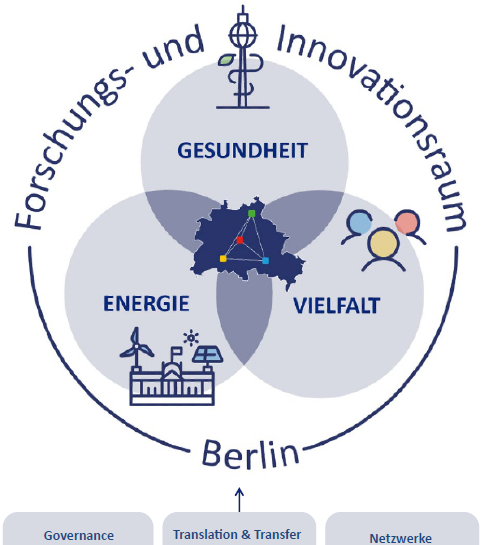
From these five profile lines of Berlin’s research, three scientific future fields have been derived, which the BR50 institutions jointly assess as particularly promising. These three research fields (energy, health and diversity) offer key research topics that BR50 intends to further develop in a targeted manner in the coming years in close cooperation with other research partners.
- Transformation through Berlin-specific research fields
Berlin’s strength as a research hub lies, compared to other science areas, in the variety and diversity of its research topics, due to the number of research institutions based here. Nevertheless, the scientific profile lines identified by BUA and BR50 as Berlin’s research strengths (see Chapter 1) leads to the identification of outstanding specialized topics. These are the researc fields of energy, health, and diversity (see Chapter 2). From basic research to application, Berlin possesses the necessary expertise in these subject areas to shape social and economic development. These three Berlin-specific research fields are not intended to imply that other research topics are less important or can be omitted.
- Transformation Through Governance
To be competitive, Berlin as a research landscape requires, next to thematic priorities, administrative wisdom and the removal of barriers that hinder collaboration. In Chapter 3, we therefore present measures that allow a smooth, effective, and thus successful collaboration.
- Transformation Through Translation and Transfer
Science that remains confined to its own walls does not advance society, the economy, or politics. Innovation does not emerge, trust in science is not strengthened, and neither is the vital social solidarity. Translation and transfer are indispensable for a knowledge and innovation ecosystem. In Chapter 4, we present targeted measures to strengthen transformation and transfer.
- Transformation Through Networks of Berlin’s Research Landscape
The scientific community must actively network with all stakeholders and work together to build bridges between different sectors of society. Promising approaches are outlined in Chapter 5. A connected research landscape requires leadership. This role falls to the Senate Department for Higher Education and Research, Health, and Long-Term Care. However, for the transformation of the research landscape, it is important that all departments of the Berlin Senate recognize that science is a powerful economic factor and is essential to a society based on solidarity.
If you have any questions or suggestions, please contact the BR50 office.
Contact:
Dr. Anja Sommerfeld
BR50 Office Berlin Adlershof
sommerfeld[at]fv-berlin[dot]de
In September 2024 BR50 produced and published, commissioned by the Senate Department for Higher Education and Research, Health, and Long-Term Care, a report on the added value generated by non-university research institutions (AUFE) in Berlin. The report is based on data from official statistics, surveys within the BR50 network, relevant analyses about the AUFE in Berlin that have been approximately updated and studies of selected innovation hubs and research institutions in Berlin. Hence, it should be understood as an approximation and not as a comprehensive study.
Numbers and Facts about the added value generated by AUFE in Berlin
- Berlin has almost 90 AUFE and 52 of them are involved in BR50 as full or associate members
- Employment effects (2023): approx. 34,000 (corresponds to around 1.6% of all jobs in Berlin)
- Persons directly employed at AUFE: 22,250
- Indirect and induced employments due to AUFE: 11,600
- For every 100 people employed directly at the AUFE, there are a further 52 jobs in Berlin
- Gross added value (2023): Estimated at 1,650 million euros (excluding tax reflows)
- That means, AUFE generate a gross added value of eight euros per invested Berlin-state euro. This value is based on a very conservative estimate of the gross added value generated by the AUFE and does not take into account wage increases, etc. A gross added value of ten euros per invested state euro, as determined for the year 2010 (TSB study 2013), is therefore still realistic.
- Tax reflows reduce the state's investment in the Berlin AUFE (208 million euros) by around half, so that the net burden on the state is around 103.6 million euros.
- Cooperations:
- Through the excellent recruitment of the AUFE, they have actively contributed to the funding of seven Clusters of Excellence and almost 20 of the almost 30 Collaborative Research Centers (CRC) in Berlin.
- More than 180 joint appointments with Berlin universities
- Awards: Almost 40 ongoing grants from the European Research Council (ERC) since 2020
- Cultural and urban contributions: AUFE are part of the urban society, they increase the attractiveness of Berlin and attract top international talents who contribute to the diversity of Berlin
- Knowledge and technology transfer: Organisation and participation in formats for knowledge transfer to society as well as numerous patents, start-ups and collaborations with companies
- Networking for urban development: BR50 and the linkages with the Berlin University Alliance (BUA), SenWGP and SenWEB, as well as with stakeholders from business and society
If you have any questions or suggestions, please contact the BR50 office.
Contact:
Dr. Anja Sommerfeld
BR50 Office Berlin Adlershof
sommerfeld[at]fv-berlin[dot]de
Dr. Anja Sommerfeld and Dr. Gregor Hofmann published an article (German) in the journal Wissenschaftsmanagement that points out the beginnings of BR50 and its relevance for the science metropolis:
BERLIN RESEARCH 50 – AUSSERUNIVERSITÄRE FORSCHUNG IN BERLIN - Und die Bedeutung für die Wissenschaftsmetropole
Auszug aus dem Artikel:
Berlin verfügt über eine einzigartige Vielfalt und räumliche Dichte an Universitäten, Hochschulen und außeruniversitären Forschungseinrichtungen. Die fachliche Diversität ist enorm. Berlin hat somit einen einzigartigen Stellenwert in Europa, wenn nicht sogar weltweit. Jedoch wird das Potenzial zur wissenschaftlichen Zusammenarbeit in Berlin noch nicht konsequent genutzt. Auf dem Erfolg der Exzellenzstrategie aufbauend strebt Berlin einen integrierten Forschungsraum an, um die Metropolregion als weltweit führende Wissenschaftsregion zu positionieren. Mit dem Verbund Berlin Research 50 haben sich die Außeruniversitären Forschungseinrichtungen der Hauptstadt nun gut aufgestellt, um dieses Ziel gemeinsam mit den in der Berlin University Alliance zusammengeschlossenen Universitäten voranzutreiben.
Parts of the article are available free of charge.
If you have any questions or suggestions, please contact the BR50 office.
Contact:
Dr. Anja Sommerfeld
BR50 Office Berlin Adlershof
sommerfeld[at]fv-berlin[dot]de
Shortly before the election of the Parliament of Berlin on February 12, 2023, the non-university research institutions, united in Berlin Research 50 (BR50), submit a position paper (available in German language only). In it, they formulate science political demands to the future state government in order to develop Berlin into a world-leading science metropolis.
If you have any questions or suggestions, please contact the BR50 office.
Contact:
Dr. Anja Sommerfeld
BR50 Office Berlin Adlershof
sommerfeld[at]fv-berlin[dot]de